
The Nobel Peace Prize laureate believes capitalism has overlooked much of human nature. His solution isn’t to replace it, but to open the door to a different kind of business.
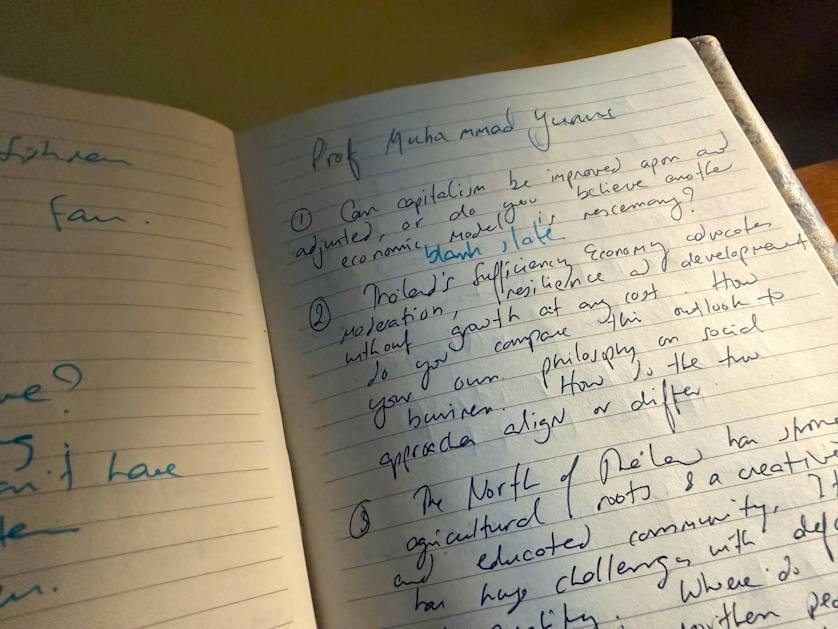
Can capitalism be improved? Adapted? Adjusted? Or, if we were starting with a completely clean slate, would we build an entirely different economic system?
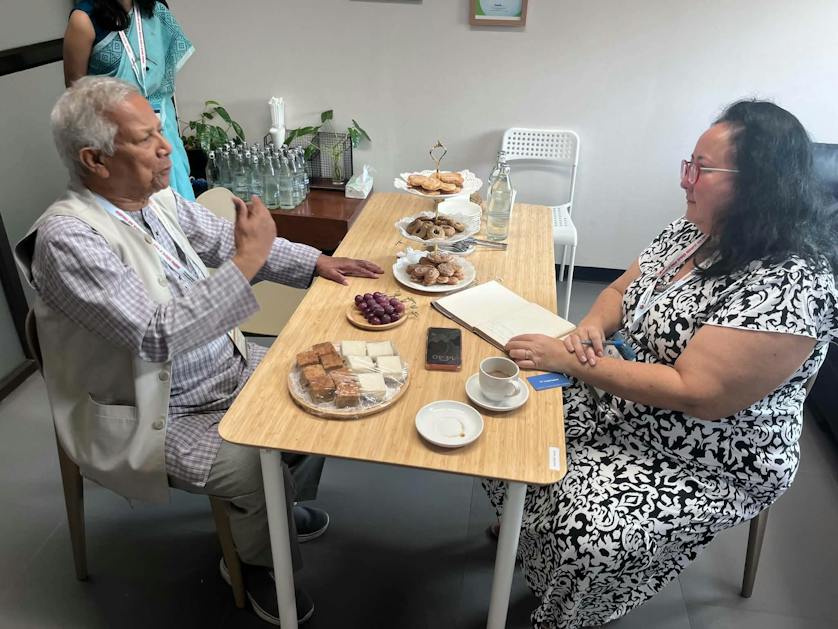
It was the one big question I wanted to put to Professor Muhammad Yunus during his visit to Chiang Mai for SBAC 2026 today. The Bangladeshi economist, social entrepreneur and Nobel Peace Prize laureate had a long line of people wanting a few minutes of his time, and since I was honoured with a private meeting, I knew I had to make my question count.
His answer was fascinating, not least because he wasn’t advocating the overthrow of capitalism. Instead, he suggested that the problem lies in something rather more fundamental: our understanding of human nature.
“Capitalism is based on selfishness,” he began. “You want to make money for yourself, your family. You’re not looking at anybody else. The more you make, the more successful you are.”
He explained that our entire economic system has been constructed around this one particular human characteristic. Competition, accumulation and personal financial success are the measures by which we judge economic achievement.
But, he argued, this is an extraordinarily narrow interpretation of what it means to be human.

“Human beings are much bigger than that. There is selfishness but there is also selflessness. Both exist, and both are significant.”
His contention is that economics has recognised and developed one side of human nature while almost entirely ignoring the other. We have created an extraordinarily sophisticated system for satisfying our desire to accumulate wealth, but where, he asks, is the equivalent system for satisfying our desire to help others?
“People do lots of things because they want to. They want to touch other people’s lives.”
He believes that helping another person, contributing to their wellbeing or solving a problem in their life can provide an enormous sense of personal satisfaction. Yet our economic theories rarely acknowledge this motivation.
Traditional economics, he argues, assumes that happiness comes from accumulation. The more money you make, the happier you become. Wealth becomes the measurement of success, and success the measurement of happiness.
“That’s a very limited interpretation of human beings,” he said, explaining, “Making money is happiness. Making other people happy is super happiness.”
It is a wonderfully simple proposition, although one that carries a rather radical implication. What if we could build an economy and a society that recognised both motivations? What if helping people could be just as legitimate a business objective as making money?
“Are you happy?” I asked.
Yunus isn’t suggesting that we abandon capitalism or dismantle everything we have built. In fact, when I asked whether he was proposing an alternative to the current capitalist structure, he was quick to clarify.
“I won’t say replacement. I would say expansion.”
His proposal is to introduce another category of business alongside conventional profit-making enterprises: social business.
“We already have one developed and super-developed on the selfish part of the business world. But you have not touched even a little bit on the selfless part. I’m opening the door. Try it.”


A social business operates commercially. It sells products or services, charges customers, covers its costs and reinvests any surplus into expanding its work. The difference is that its purpose is not to enrich its owners or shareholders. Its purpose is to solve a human or social problem.
The distinction between social business and charity is important to Yunus. He has nothing against philanthropy, but believes it has inherent limitations. Donations are wonderful, he says, but they depend on people continually giving money away. Once the money is spent, it is gone.
A social business, on the other hand, can become self-sustaining. It can generate revenue, reinvest its surplus and grow without depending on an endless stream of donations.
“You can make money for yourself and be happy. You can touch other people’s lives and be happy. And I’m saying not only be happy, just equal to the other one, you become super happy.”
He even challenges those who doubt that helping others can be personally rewarding.
“If you don’t see it, you never did it. In order to see what it is, you have to do it. Experiment with it. If you don’t like it, close the door. But at least you tried it.”
It is an invitation to experiment with human nature, rather than simply accepting the economic status quo we have inherited.
Healthcare is one of the areas where he believes social business could make an enormous difference.
“Healthcare should not be a way for people to get rich,” he said.
He argues that healthcare is too fundamental a human need to be treated primarily as an opportunity for profit. When people are sick, they are vulnerable. They need treatment, often urgently, and are hardly in a position to negotiate the price of the medicine that might make them better.
He is particularly critical of the pharmaceutical industry, questioning the enormous mark-ups on medicines and the monopolies created through patents. He believes that essential medicines should be affordable and that intellectual property protections can sometimes prevent other manufacturers from producing medicines that could be made at a fraction of the price.
“The people suffer because they need a little bit of medicine. But you make super money out of it, and nobody talks about it.”
His alternative is to make healthcare a social business.
The model he described is relatively straightforward. Establish a small hospital or healthcare centre in a village, charge patients for services at affordable rates, cover operating costs and reinvest any surplus into building another facility. As the network grows, established centres help finance new ones.
He described a network of 160 healthcare centres in Bangladesh, explaining that around half were already generating surpluses that could help finance further expansion, while the others were still working towards financial sustainability.
The ambition extends beyond small clinics. He spoke of larger hospitals, a 700-bed hospital under construction and medical colleges, all intended to operate within the social business model.
The objective, he explained, is to create an entire healthcare ecosystem that can sustain and expand itself.
“There is no healthcare system that works under the current capitalist model,” he said, emphasising that the point is not simply to establish institutions, employ people and spend government budgets, but to create efficient enterprises that actually solve the problems they set out to address.
The COVID-19 pandemic, he argued, exposed another failing of the current system. Yunus believed vaccines should have been patent-free, allowing any qualified manufacturer to produce them and preventing a handful of pharmaceutical companies from controlling supply. Efforts to secure international agreement failed, leaving wealthy nations with the lion’s share of vaccines while poorer countries struggled to access them.
For Yunus, this was not simply an unfortunate consequence of a global emergency. It was evidence of an economic system that prioritised commercial interests over essential human need.
“If it was patent-free, any country could produce it,” he argued. “So many lives would have been saved.”
He isn’t asking governments to nationalise everything, nor is he suggesting that conventional businesses should disappear. He wants us to recognise that businesses can have different motivations and that profit doesn’t have to be the only measure of success.
A conventional business might sell a product to make its owner wealthy. A social business might sell exactly the same product, cover its costs and use its surplus to establish another enterprise that helps more people.
Both can operate. Both can generate employment and economic activity. But their objectives are fundamentally different.
He isn’t asking us to stop being ambitious, entrepreneurial or even selfish. He is asking us to acknowledge that we are capable of something else, too.
His challenge is to open the door and see what happens when we build an economy that gives equal consideration to both sides of human nature.
Unfortunately, our time was running out. Yunus is, understandably, a much-in-demand man, and there were plenty of other people waiting for their opportunity to speak with him.
But I had one final cluster of questions. “If you can’t assign value to happiness then how do you measure it? How do you incentivise people to try it? How do you build it into an economic system? And if it cannot be quantified, might that be precisely why it has been so overlooked?”
He gave me a smile and a small nod.
And then he was gone.
I wish we’d had another five minutes.
A little more from Professor Yunus: two further questions:
Ahead of our interview, I had sent Professor Yunus two additional questions by email. His responses arrived after this article had been published, and we are pleased to share them here as a follow-up to our conversation.
You have seen social business take root around the world. Is there a particular real-life story or community example that has moved you recently, something that shows what happens when a business is built purely to solve a social or environmental problem?
When I think of a story that shows what happens when a business is built only to solve a problem, I think of Grameen Kalyan. This year, it has completed thirty years.
It began quietly. In 1993, there were eight small primary healthcare centres in rural Bangladesh. A poor family does not stay poor only because it lacks capital. It stays poor because one illness can undo everything. A father falls sick, the savings are gone, the land is sold, and the family is back where it started. You cannot give people a loan and then leave them unprotected against sickness. Health and poverty are the same problems seen from two sides.
So we asked whether healthcare could stand on its own feet. Not as charity, which depends on someone’s kindness every year, but as a social business: patients pay what they can, the revenue pays for the service, and every surplus goes back into the work.
Many people said it was impossible. They said healthcare for the poor would always lose money. Now look at what has happened. From eight centres, we have grown to 160 across Bangladesh. About 750,000 patients are served every year. In August, September and October of this year, cost recovery was above 100% each month. This is not a promise anymore. It is a result. Affordable healthcare and financial self-sustainability can live together.
If you look at the older centres, you will see that cost recovery is above 100%, and these are not in rich places. They are in villages. The people there are not being served because someone was generous to them. They are being served because the system was designed well.
What moves me even more is what the community did. Families have given their own land, and some of their buildings, so that a health centre can stand in their village. Nobody asked them to do this as a favour to a company. They did it because they trust it. Six such places exist now. A donor gives land once, and the benefit continues for generations because the business keeps itself alive. This is the difference between a gift that is consumed and a gift that keeps working.
And the service does not stand still. Today, the village centre has a diagnostic laboratory. Bangladesh’s first rural-based molecular laboratory is in Savar, bringing tests for hepatitis, tuberculosis and dengue closer to people who once had to travel to the city. There is cataract surgery. There is HPV DNA screening, so that a rural woman can be checked for cervical cancer early, when it can still be treated. The government has recognised this work. A woman in a village should not receive worse medicine simply because she lives in a village.
I say to all young people: do not think that social business is a smaller kind of business. It is a harder one because it must be efficient and kind at the same time. But when it works, as it has here, nobody can say it is a dream.
Now the vision is to go from 160 to 300 centres by 2030 and to open two secondary hospitals. I believe it can be done because the first thirty years have already answered the question of whether it can.
You’re here in Chiang Mai for the Social Business Academia Conference, surrounded by educators and students. How can universities better inspire young people to look at challenges in their own communities and feel confident that they can build practical solutions themselves?
In 1974, I was a young professor of economics at Chittagong University. I stood in front of my students and taught them beautiful theories, elegant equations and models of how markets bring prosperity. Outside the classroom window, people were dying of hunger. The famine was all around us. I felt ashamed. What use was all my knowledge if it could not help a single person on the other side of the university wall?
So I did something simple. I walked into the village next to the campus. I was not a researcher with a questionnaire, only a curious person who wanted to see how I could help them. There, I met women trapped by tiny debts, and I understood more there than I had from years of textbooks. I took the students out of the classroom and let them sit with the women who sold handmade baskets and listen.
We must change what we tell young people they are here for. Universities are telling them to study hard, get good grades and find a good job. That makes a student a job seeker. But every human being is born an entrepreneur, with imagination and the ability to create.
Students are told that business has one purpose: to make money. But human beings are not one-dimensional. They have compassion, idealism and wishes to change the world. When they see that a company can be designed to solve a problem, with no dividends and every surplus going back into the mission, something opens in them. They say, “So I can do this too.”
That is why we have encouraged social business centres in universities around the world, where students can bring their ideas, form teams and test them in real life.
I would say to every university: measure yourselves differently. Do not only count how many graduates found jobs. Count how many problems your students solved in the communities around you. Count how many of them started something that did not exist before.
We are not born to be workers in someone else’s design. We are born to create. If a university helps a young person remember this, then the future will take care of itself.
