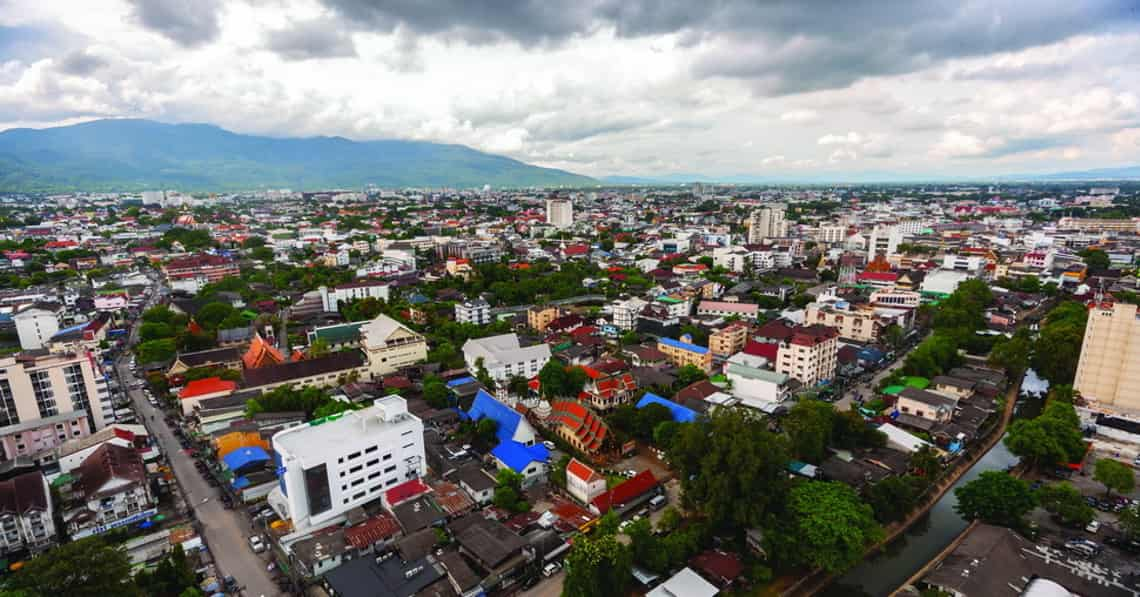
Chiang Mai today is navigating a delicate balancing act — pursuing international recognition for its Lanna heritage while managing the pressures of rapid urban growth, a shifting tourism economy, a shortage of specialised heritage expertise, and a population that increasingly wants a greater say in how their city is run. The next twelve months may well determine the shape of the next century.
Ten years in the making
Chiang Mai’s path to potential UNESCO World Heritage status has been a decade in the making — you can read our 2020 article for detailed background. The city was first placed on Thailand’s tentative list ten years ago, a milestone that felt, at the time, like the beginning of a long and uncertain process. While we are still waiting with bated — and uncertain — breath, things are progressing.

The nomination dossier, titled Chiang Mai, the Capital of Lanna, was submitted to the UNESCO World Heritage Centre by the 30th January 2026 deadline. Led by Thailand’s Ministry of Natural Resources and Environment and approved by the National Committee for the World Heritage Convention, the nomination makes the case for Chiang Mai’s outstanding universal value as the former capital of the Lanna Kingdom, a centuries-old centre of Theravada Buddhism, and a city whose streets, temples, and ancient walls carry the architectural and cultural fingerprints of a civilisation that flourished here for more than seven centuries.
The proposed heritage area covers 383 rai of the historic centre — approximately 151 acres — encompassing seven major temples, the ancient city walls, five gates, four corner bastions, and the old moat. The government worked closely with public and private stakeholders throughout the process, and its approval by the National Committee represents a genuine consensus that this is worth pursuing. If successful, Chiang Mai will become Thailand’s first UNESCO World Heritage site situated entirely within a living, populated community — a distinction that is both the nomination’s greatest strength and its most complex challenge.

A city, not a park
Walk through the old city on any given morning and the heritage the nomination describes is not behind glass. It is the monk collecting alms outside Wat Chiang Man before the city
has properly woken up. It is the grandmother burning incense at Wat Phra Singh while tourists queue for photographs nearby. It is the family whose shophouse sits metres from a 700-year-old chedi, and who has no particular interest in relocating to make the streetscape tidier for an inspection team.
This is precisely what distinguishes Chiang Mai from Thailand’s existing World Heritage sites. Sukhothai and Ayutthaya are managed as historical parks — carefully preserved, carefully controlled, and largely emptied of the daily human activity that once animated them. Chiang Mai is a provincial capital of nearly a million people, with the traffic, commerce, construction, and contradiction that implies. For the UNESCO nomination to succeed, it must demonstrate not just that Chiang Mai’s heritage is significant, but that it can be protected within — and not at the expense of — the living city that surrounds it.
The seven temples at the core of the nomination are not simply beautiful buildings. They are waypoints in a story that still has active chapters being written. Wat Chiang Man, the oldest, was founded by King Mangrai himself. Wat Jet Yod was built to host the Eighth World Buddhist Council in 1477, drawing monks and scholars from across the Buddhist world. Wat Phra That Doi Suthep, visible from almost anywhere in the city, has been a place of pilgrimage for centuries and remains so today. Wat Phra Singh houses the revered Phra Singh Buddha image and stands as a masterpiece of Lanna religious architecture. Wat Chedi Luang’s great chedi once towered as the tallest structure in the kingdom before lightning struck it in 1545, reducing it by nearly half. Wat Suan Dok, founded in the 14th century, remains an active centre of Buddhist learning and the resting place of Chiang Mai’s royal lineage. Wat Umong’s forest setting and ancient tunnel network feel unlike anywhere else in the city. These are living religious sites — which is both their greatest strength as a nomination and their most significant management challenge.

Mind the gap (between policy and community)
A collaborative research project involving Deakin University, Chiang Mai University, and UNESCO Bangkok has shed some uncomfortable light on how heritage is actually managed here. Piloting UNESCO’s Competence Framework for Cultural Heritage Management across the city’s key sites, the study uncovered a tension that will be familiar to anyone who has watched local governance up close.
Government agencies — in particular the Fine Arts Department — are adept at applying laws and regulations. What they often lack is meaningful understanding of community rights and traditional knowledge. Local communities, meanwhile, hold generations of cultural understanding but have limited familiarity with formal heritage frameworks. The
result is a system where the people who know the rules don’t always know the place, and the people who know the place don’t always know the rules.
The research also flagged a more structural problem: a shortage of specialised expertise within local branches of national agencies. Architects, landscape architects, and anthropologists — the kinds of professionals whose skills are essential to sensitive heritage management — are thin on the ground at the local level and are not yet meaningfully integrated into the current process. Decisions that require nuanced, site-specific knowledge are too often being made by generalists working from Bangkok-issued frameworks.
The study’s central recommendation is the creation of a coordinated management authority capable of bridging the currently siloed worlds of government agencies, religious institutions, and local residents. A participatory, community-centred approach, the researchers argue, is not just preferable — it is essential. Without it, even a successful UNESCO nomination risks becoming a framework that looks coherent on paper but struggles to function on the ground.

The inspection team from UNESCO/ICOMOS arrives in June 2026. A final decision is expected by November. Between now and then, Chiang Mai must demonstrate not just the beauty and significance of what it has preserved, but its institutional readiness to protect it — a considerably harder argument to make, and one that heritage managers and city officials are still actively working out.
Tourism finds new footing
Running alongside the heritage bid is a tourism sector in the middle of a quiet reinvention. Chiang Mai welcomed a record 12 million visitors in 2025 — four million of them from overseas — and the market looks noticeably different from a decade ago. While China remains significant, growth is increasingly coming from South Korea, Japan, Taiwan, and longer-haul markets including the United States and United Kingdom. The shift is deliberate, reflecting a broader recognition that over-reliance on any single market carries risk.
Health and wellness tourism is emerging as a cornerstone of the province’s future strategy. The San Kamphaeng Hot Springs has been earmarked for a 198-million-baht redevelopment, with the ambition of transforming the site into a nationally recognised wellness destination by 2030–2031. If projections hold, annual revenue there could grow from roughly 40 million to 100 million baht — modest numbers in isolation, but meaningful as a proof of concept for a wider wellness offering.

Elsewhere, operators are adapting in real time. Maetaeng Elephant Park, still recovering from the twin blows of the pandemic and major flooding, is redirecting its focus toward Indian, Middle Eastern, and Southeast Asian visitors as it rebuilds. The UNESCO nomination, if successful, would provide an additional layer of international credibility to the city’s tourism offer — and, in theory, a framework for ensuring that heritage sites are not simply consumed by the visitor numbers they attract.
A city that wants to govern itself
Perhaps the most quietly consequential debate unfolding alongside all of this is a push for administrative reform that rarely makes international headlines but matters enormously to the people who live here. The advocacy group iLaw is championing the proposed Chiang Mai Metropolis Act, which would allow the city to become a self-governing metropolis — with residents electing their own governor and city council, and exercising fiscal and municipal authority independent of Bangkok, along the lines of the model already in place in Pattaya.
The argument for decentralisation is straightforward: a city as complex and fast-evolving as Chiang Mai needs governance structures that are responsive, locally accountable, and capable of making decisions at the speed the city demands. Heritage management, tourism planning, infrastructure, and environmental policy are all areas where local knowledge and local accountability could, in theory, produce better outcomes than directives issued from a distant capital.

Opinions among residents are divided. Supporters believe local governance would mean better, more responsive resource allocation — particularly relevant as Chiang Mai navigates the simultaneous pressures of heritage preservation, tourism growth, and urban development. Sceptics worry it could open the door to increased political volatility or corruption closer to home. It is, in many ways, a microcosm of the larger questions Chiang Mai is asking itself: how much of its future does it want to control, and what is it prepared to risk in order to get there?
What a yes would mean
A positive decision from UNESCO in November 2026 would do several things simultaneously. It would cement Chiang Mai’s international standing in a way that no tourism campaign could replicate. It would unlock new frameworks — and potentially new funding — for heritage conservation. And it would, in theory, provide a degree of protection for the old city against the kind of development pressures that have already reshaped so much of the urban landscape beyond the moat.
But recognition also brings obligations, oversight, and scrutiny. Cities on the World Heritage List are expected to report regularly to UNESCO, to demonstrate that their management plans are being implemented, and to flag any threats to the site’s integrity. For a living city with competing development interests, active religious institutions, and a governance structure that currently leaves most major decisions in Bangkok’s hands, meeting those obligations consistently will require a level of coordination and institutional capacity that does not yet fully exist.
That is the work of the coming months — and, if the nomination succeeds, the work of the coming decades. Chiang Mai has spent 730 years becoming what it is. The question now is whether it can agree, collectively and clearly enough, on what it wants to be next.
The UNESCO/ICOMOS inspection team is scheduled to visit Chiang Mai in June 2026. A final decision on World Heritage status is expected in November 2026.
